
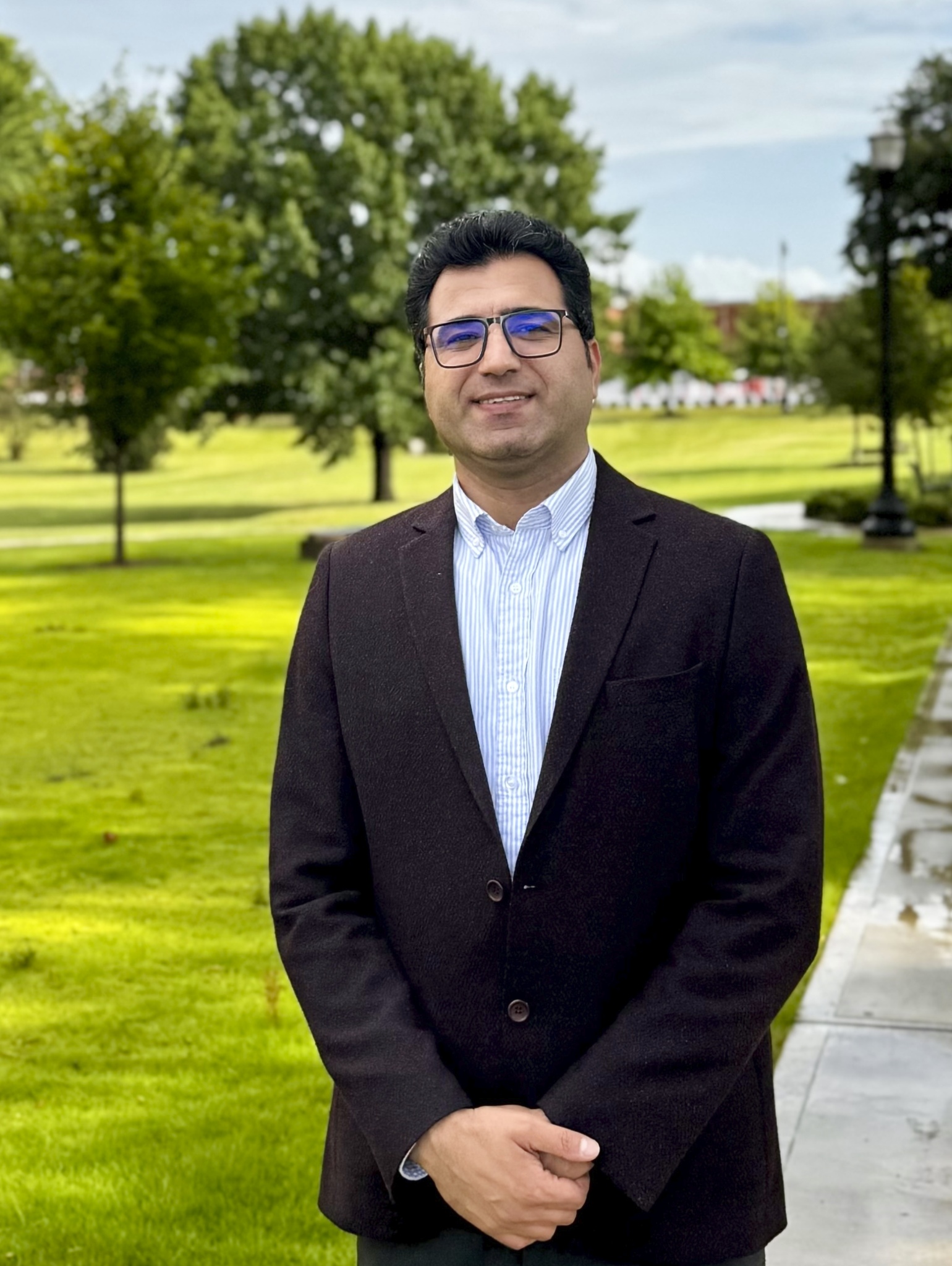
TUSCALOOSA, Ala. — The Alabama Water Institute recently welcomed Dr. Hazhir Karimi as a postdoctoral researcher in the Community Oriented Nature-based Science for Ecosystem Restoration and Versatile Engineering, or CONSERVE, Research Group.
Karimi earned his Ph.D. from the Department of Geography and Environment at The University of Alabama, with a specialization in geographic information science, or GIS, and geospatial science. This is his second degree from UA, as he had previously earned a master’s degree in biology from the Department of Biological Sciences.
His work at CONSERVE will combine his expertise in these fields to address complex challenges related to water resources, land-use planning, ecosystem services and environmental decision-making.
“CONSERVE’s mission and projects closely align with both my research background and the type of work I have done and hope to pursue in the future,” Karimi said. “As a result, in this role, I work with a collaborative team to conduct interdisciplinary research and contribute to innovative, applied solutions that strengthen watershed and ecosystem health and resilience.”
Building a Global Career in Water Research
After earning his first two degrees in environmental science while in Iran 12 years ago, Karimi transitioned into industry, working as a project manager and consultant. As a consultant, he led multidisciplinary teams to deliver GIS, natural resource management and environmental assessment support to a diverse range of environmental and resource management initiatives.
Following his stint in consulting, he joined the University of Zakho in the Kurdistan Region of Iraq as a lecturer in the Department of Environmental Science and research scientist in its Center for Applied Remote Sensing and GIS. Now part of academia, Karimi pursued research projects that were both interdisciplinary and transnational, exploring questions surrounding how ecosystem changes impact environmental quality and water resources. This exploration led to collaborations with Xiamen University in China and transboundary rivers research in the Middle East.
“I’ve worked in multiple countries with more than 10 institutions and consulting firms, collaborating with professionals around the world,” Karimi said. “Speaking different languages, engaging with the scientific community, presenting research at conferences and working with stakeholders and the public have given me valuable experience collaborating with people from diverse backgrounds, perspectives and professional levels.”
During that time, Karimi served as the first author of “Practical Skills in GIS,” a 490-page textbook for people interested in learning how GIS can be applied in different research and professional contexts.
“I’m really happy the book works for both academia and industry, as I always get messages and feedback from students and consulting firms that do GIS work,” Karimi said. “The reason, I think, is that I have experience in both places and as a result, my coauthor and I were able to design the material to meet the needs of our different audiences.”
In addition to the book, he has also authored 40 papers and book chapters.
Coming to CONSERVE
Karimi’s journey to CONSERVE did not begin with the postdoctoral position. He had previously worked with AWI, supporting the Research Experience for Undergraduates program hosted by The University of Alabama Graduate School and the Cooperative Institute for Research to Operations in Hydrology every summer. His time with AWI exposed him to some of the institute’s research entities, one of which was CONSERVE.
He remembers reviewing CONSERVE’s websites and learning about the interdisciplinary projects and community-oriented environmental research. That curiosity led him to Dr. Michael Fedoroff, director of the CONSERVE Research Group.
“I became interested in the team, so I reached out to Dr. Fedoroff to inquire about a potential postdoctoral opportunity; he invited me to meet, we discussed the possibilities, and it worked out,” Karimi said.
He resumed his work with the team this June, a few weeks after graduating with his Ph.D.
Keeping Up with Our Watersheds
Karimi’s research project at CONSERVE will focus on watershed and ecosystem dynamics, allowing him to build directly on his research experience and expertise in GIS, hydrological analysis and ecosystem modeling. Specifically, he will be working on the Choctawhatchee-Pea River watershed project funded by the CRIMSON Water Initiative and located in South Alabama and West Florida.
Using environmental datasets, Karimi will evaluate long-term trends in water quality, habitat quality and aquatic ecosystem health across space and time. By integrating water quality indicators with biological assessments of fish and other aquatic organisms, Karimi aims to identify how watershed conditions affect ecosystem health and resilience over time.
“I want to write some high-quality papers from this project,” Karimi said. “I’d also like to share my findings about water and habitat quality conditions with landowners and stakeholders. Knowing how land use and changing conditions impact water quality is very important.”
His first year, however, will be dedicated to collecting data and refining his research questions.
A Future in Environmental Conservation
Since moving to the United States four and a half years ago, Karimi has carried the same interests with him, even as he transitioned between departments. As he looks beyond his Ph.D., he hopes to continue making these inquiries and sharing his knowledge with the next generation of hydrologists.
“My long-term goal is to do research,” Karimi said. “I still see CONSERVE and AWI as a long-term place for myself, because here I can do my own research and also collaborate with others. Teaching is also very important to me. I have taught in Iran, in the Kurdistan Region of Iraq and here in the U.S. I really enjoy working with students and sharing what I have learned through my research and experience.”
This new chapter represents a step in the right direction for the CONSERVE team, reinforcing its commitment to supporting research that addresses real-world environmental challenges.
“The CONSERVE team is very lucky to have Dr. Karimi join our ranks,” Fedoroff said. “His work ethic, attention to detail and novel insights have already generated research products that support healthy watersheds in Alabama and beyond.”
Written by Theola Amiokhaibhor
The Alabama Water Institute is one of The University of Alabama’s research institutes. AWI acts as a forum for interdisciplinary research and education by bringing together University researchers, students and staff to foster collaboration and a broad interdisciplinary focus on water issues that face our world today. AWI-affiliated researchers specialize in hydrologic and hydraulic modeling, water security and quality, remote sensing, biodiversity and watershed management and human health through synergies with AWI research programs, including the NOAA Cooperative Institute for Research to Operations in Hydrology, the Global Water Security Center and the CONSERVE Research Group.