
TUSCALOOSA, Ala. — Ekaterina Menkina, a University of Alabama anthropology student, had never touched professional filming equipment before. However, the Alabama Water Institute’s CONSERVE Research Group took a chance on her in 2024, handing over professional-grade camera equipment and trusting her to document ancient pictographs 800 miles from Tuscaloosa.
“I saw the words ‘creative’ and ‘art,’ and I immediately thought I needed to look into this,” Menkina said about the grant opportunity that sparked everything. “Sometimes opportunities come so suddenly that you don’t realize the deadline is tomorrow or the same day, so you just have to work with what you have and make a decision.”
That split-second decision to apply for the Levitetz Leadership Program and Innovation Seed Grant, and CONSERVE’s willingness to support a first-time filmmaker, launched her into a new role as multimedia specialist with CONSERVE’s storytelling studio.

An Advisor’s Introduction
The connection happened naturally. Associate professor and CONSERVE faculty affiliate Dr. Catherine Chiou, Menkina’s advisor in UA’s anthropology department, discovered Menkina needed technical resources for documenting pictographs at Paint Rock. Chiou connected her with the CONSERVE team.

CONSERVE provided several cameras, a tripod and other essential gear for fieldwork. More importantly, they extended unusual flexibility, allowing the equipment to leave campus for an extended period.
“The media center here on campus does not allow you to take equipment outside of the state at all,” Menkina said. “The fact that CONSERVE allowed me to check this out for a month was incredible. The whole project was in west central Texas, quite a distance away.”
CONSERVE saw opportunity beyond one project. “We need somebody to learn how to use this equipment so that they can help later train other people,” Dr. Michael Fedoroff, director of CONSERVE, told Menkina.
Learning the Hard Way
The Paint Rock cliff site tested her immediately. High rock faces were covered in cacti. Surfaces were uneven. Ancient pictographs were positioned high above, requiring careful climbing with expensive equipment.
“Imagine having to drag a very big camera on your neck and going up because the majority of the pictographs are located very high above,” Menkina said. “You have to climb up, but also carefully navigate so you don’t shatter anything.”
She was also tested after completing the shoot during the postprocessing phase.
“I had to compensate for my lack of skills in the editing process,” she said. “Learning how to fix clips, how to fix audio in so many ways.”
The challenges taught lessons no classroom could. She practiced aerial drone photography and photogrammetry, stitching multiple photos together to create three-dimensional models. She conducted her first formal interviews. She discovered how lighting, angles and timing affected storytelling.
Building CONSERVE’s Science Communication Capacity
While CONSERVE supported her project, Menkina began helping the research group in return. Fedoroff was starting restoration ecology work and wanted to communicate that research to broader audiences.
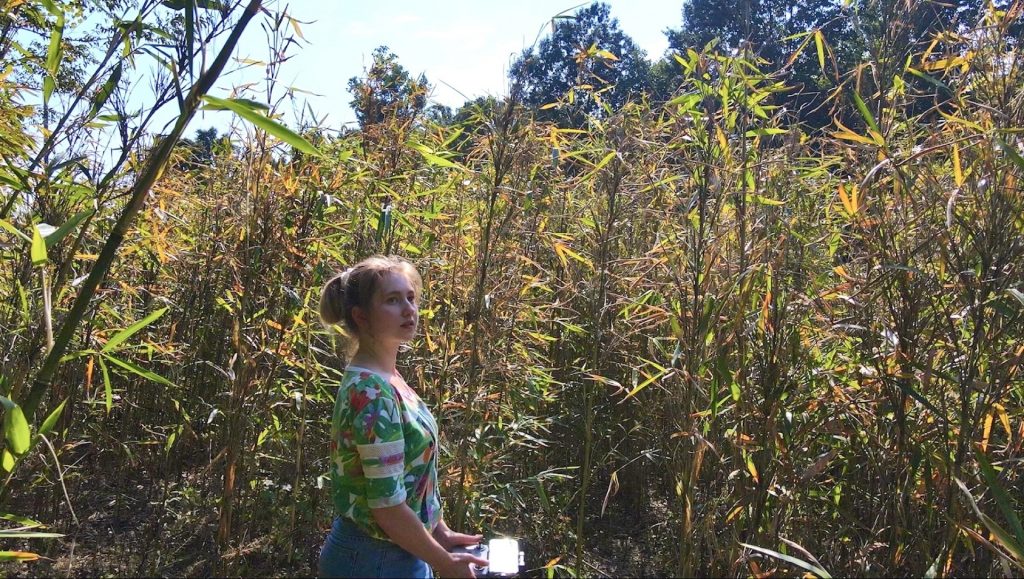
“I started to help them and gain more skills in the field, going with them to different restoration sites,” Menkina said. “That’s kind of how I officially later joined CONSERVE.”
Her role evolved from equipment borrower to conservation storyteller. Working with graduate research assistant Parker King and Chiou, she helped construct the media lab.
“It’s very much a team effort,” Menkina said. “You need the support. I learned that the hard way at Paint Rock working solo for the first trip.”
Telling Conservation Stories
As multimedia specialist, Menkina produces video projects, podcasts and visual content that brings CONSERVE’s research to broader audiences.
One significant project documented rivercane restoration work with the Choctaw Nation of Oklahoma and Westervelt Ecological Services. Rivercane, a keystone species, has nearly disappeared from Southern landscapes, affecting both ecosystems and the cultural practices of Indigenous communities.
“We quickly realized that our community partners desired their rivercane stories be heard and documented for future generations,” Fedoroff said.
This CONSERVE project, led by Fedoroff, is the largest rivercane restoration effort ever undertaken in Alabama and demonstrates the successful application of restoration science and science communication. The public exposure led to a second project to better understand management of existing rivercane stands for bird habitat, resulting in better conservation outcomes and the revitalization of traditional Choctaw basket weaving.
“Working alongside elders from the Jena Band of Choctaw, we learned the art of thinning a cane stand to encourage new growth,” Menkina said. “A practice of patience, observation and respect.”
The documentation serves multiple purposes. It increases visibility for restoration projects, shows community-based approaches to conservation and demonstrates to potential partners how CONSERVE works alongside affected communities.
A Lasting Impact
The Paint Rock documentary continues to evolve. Working with collaborator Verenis Amezcua, a graduate student from Harvard University, Menkina is preparing to release the full film in summer 2026. “The Light Within the Shadows: Ritual, Myth and the Underworld” will showcase large-scale 3D models of the cliff site and animations of pictographs
Her focus has shifted to conservation stories for the research group. Her work appears across social media channels and YouTube, where projects like the rivercane restoration documentary demonstrate how scientific research intertwines with cultural preservation.
“If I wasn’t involved with CONSERVE, I don’t think I would have found love towards filming and documentation,” Menkina said. “It has changed absolutely everything.”

For CONSERVE, the investment in one student has multiplied. Menkina trains multiple students using the equipment she borrowed, passing along skills she learned just months earlier. Her path from first-time filmmaker to multimedia specialist shows what’s possible when students seize unexpected opportunities.
Alabama’s watersheds hold nationally recognized ecological diversity, with unique plants and animals found nowhere else in the world. The CONSERVE research group at The University of Alabama, along with its collocated partners including NOAA, USACE, National Water Center, USFWS and USGS, works to deliver nature-based watershed conservation practices that enhance all communities depending on healthy watersheds.
The Alabama Water Institute (AWI) is one of The University of Alabama’s four research institutes. AWI acts as a forum for interdisciplinary research and education by bringing together university researchers, students, and staff to foster collaboration and a broad interdisciplinary focus on water issues that face our world today. AWI-affiliated researchers specialize in hydrologic and hydraulic modeling, water security and quality, remote sensing, biodiversity and watershed management, and human health through synergies with AWI research programs, including the NOAA Cooperative Institute for Research to Operations in Hydrology, the Global Water Security Center, and the CONSERVE Research Group.