
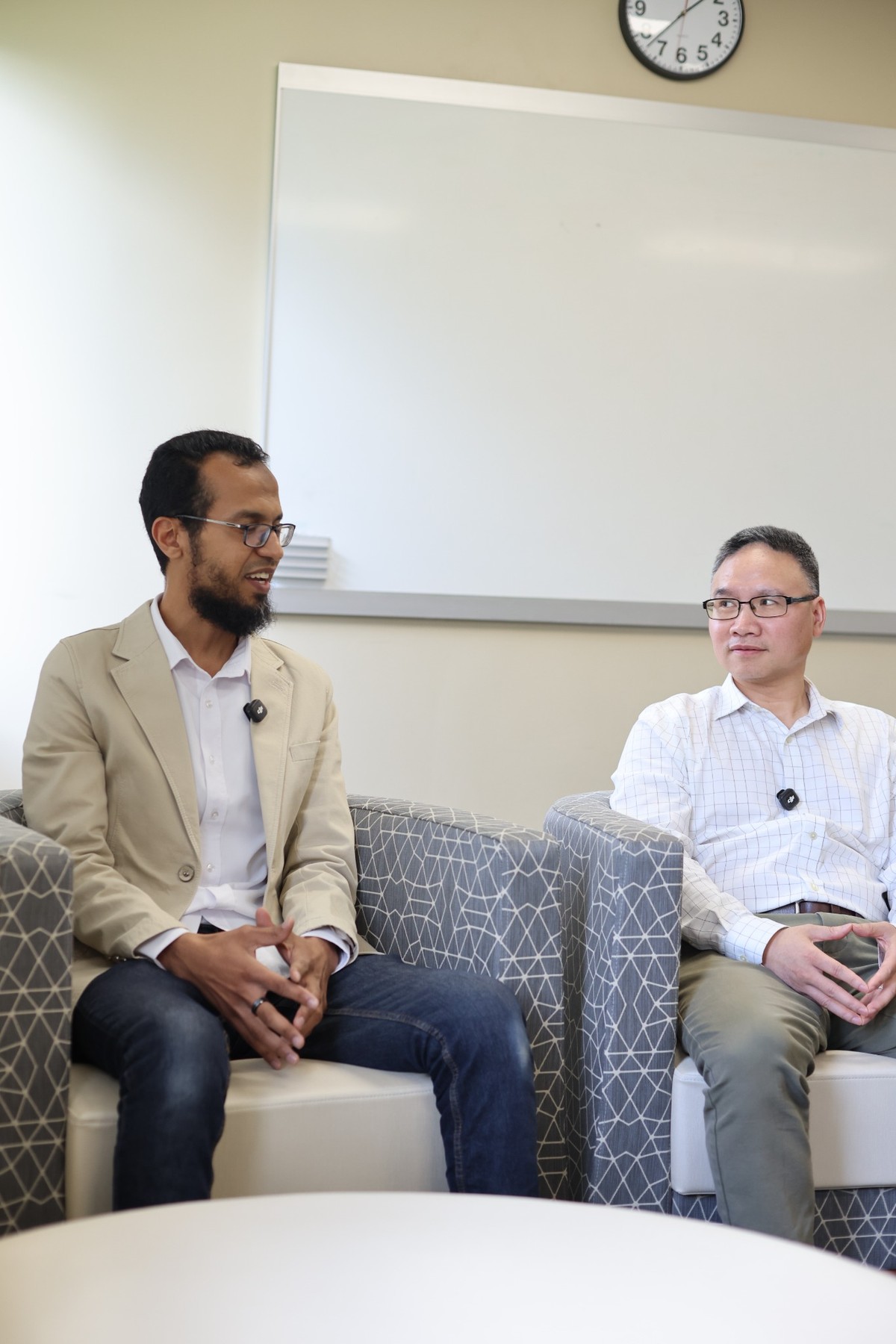
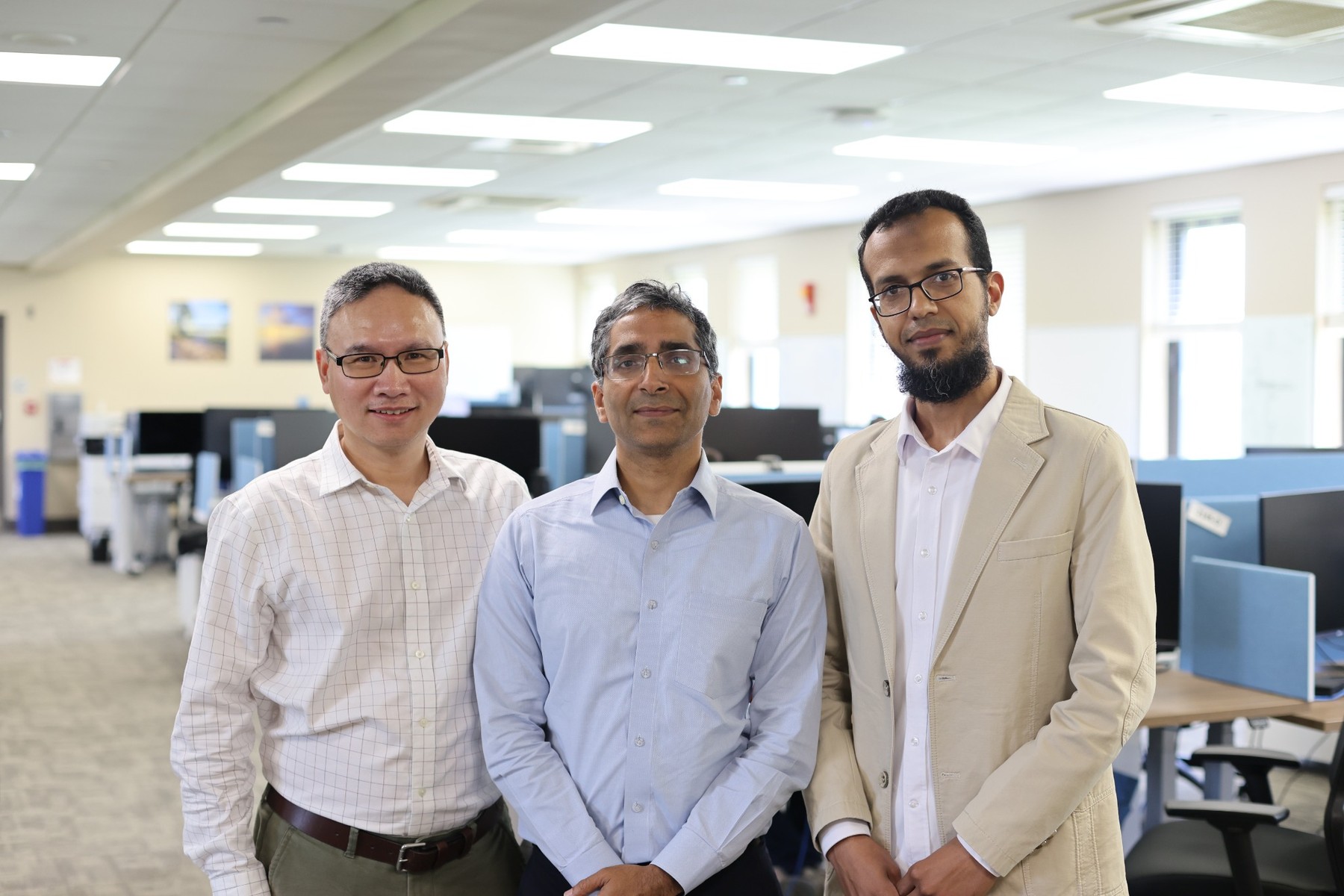
TUSCALOOSA, Ala. — Predicting extreme wet or dry conditions is challenging enough. Predicting when one may quickly give way to the other adds another layer of complexity. This summer, the Cooperative Institute for Research to Operations in Hydrology, or CIROH, brought together visiting scholars Dr. Mohamed Fathi Said and Dr. Wei Zhang with Dr. Mukesh Kumar to tackle that challenge while building a collaboration they hope will continue long after the program ends.
The CIROH visiting scholars program provides researchers with the resources they need to advance their research into actionable results, from computing power to collaboration with scientists affiliated with on-site federal agencies like the National Oceanic and Atmospheric Administration’s National Water Center, or NOAA NWC, and the United States Geological Survey’s Hydrologic Instrumentation Facility, or USGS HIF. Through the program, researchers make leaps in their research goals and create a foundation for lifelong collaboration and friendship.
“We were able to make significant headway with our project goals, which we believe will directly impact hydrologic forecasting,” said Kumar, professor of hydrology and water resources in the Lee J. Styslinger Jr. College of Engineering at The University of Alabama and current Alabama Water Institute fellow. “But beyond the research, having that friendship develop during this time is what I cherish. That’s the biggest thing to come out of this program for me.”
From Networking Opportunities to Partnerships
This summer was not the first time that Kumar and Said collaborated. Said is an assistant professor of civil engineering at Florida Gulf Coast University focusing on using artificial intelligence and deep learning in water resources, while Kumar works on the prediction and understanding of hydrologic processes across the hydrologic continuum. When Kumar met Said at a conference in late 2024, they immediately recognized the potential of their collaboration.
A few months later, in the summer of 2025, Kumar hosted Said in Tuscaloosa for the first time. Together, they submitted a white paper based on their findings.
“It turned out to be a very productive and reinvigorating partnership,” said Kumar. “This year, he expressed interest in coming back to this program, so I was delighted to hear that.”
The two researchers made plans for Said to return the next summer. Meanwhile, Kumar and Zhang, an associate professor of climate science at Utah State University, crossed paths at the annual CIROH Science Meeting held in Tuscaloosa. Zhang was leading a CIROH project, and had already heard about the visiting scholars program during the monthly CIROH meetings.
Right away, Kumar and Zhang noted a mutual interest in each other’s work. A few months later, Kumar traveled to Logan, Utah, to give a talk at USU. After more substantive discussions and Zhang’s application to the program, the plan was set for Zhang to join Said as a visiting scholar in 2026.
“I thought it was a great opportunity for me to come here to work in person with Mukesh on some exciting projects,” said Zhang. “That’s why I applied, and then I got selected. I was so excited to come here in June to work with Mohamed and Mukesh.”
Narrowing the Research Topic
During early discussions with Kumar after Said and Zhang arrived, they narrowed their research topic to hydroclimatic whiplash, which is the rapid transition from drought to flood. Kumar, Said and Zhang recognized this as an urgent subject as the variability of precipitation increases globally, threatening the safety of millions of people.
“The research we’ve been working on here is a challenge because even understanding or predicting droughts or floods is very challenging, not to mention that transition between those two types of extremes,” said Zhang. “So, we are really testing the limits of the modeling and pushing the boundaries of forecasting.”
Even though the research topic posed a challenge, Kumar, CIROH and its partners provided Said and Zhang with all the resources they needed to make progress. Training deep learning models requires huge amounts of computational power. This program provided them with access to high-performance computing multiple times over the summer, enabling them to train models for prediction and forecasting.
In addition to computational resources, CIROH also arranged conversations with scientists from nearby federal partners, like NOAA’s Office of Water Prediction and the USGS HIF, to help Said and Zhang understand how they could contribute to the translation of their research into operations.
“It’s a very valuable experience to be here with CIROH,” said Said. “We have many brilliant people here, and interacting with them and having discussions is a big experience. It’s not easy to find this in other places. So, of course, I encourage everyone to come here.”
Distraction-Free Collaboration
The visiting scholars program also gave Said and Zhang time to take a break from their daily routines to focus on research. At their home universities, Zhang and Said’s days involve meetings, teaching classes and mentoring students. As visiting scholars though, they can get away from distractions to code, debug and have in-depth discussions with their collaborators.
Those discussions between Kumar, Said and Zhang stood out as their favorite parts of the summer. The dialogue shared by the three researchers strengthened them as collaborators, researchers and friends.
“We three have a little bit different backgrounds, so during our discussions those ideas would help us to broaden our horizons and our research,” said Zhang.
“We recognize each other’s strengths, and the skill sets that we bring,” said Kumar. “I always feel that the collaborations where we can complement each other’s skill sets are the most fruitful and lead to much more impact.”
From Collaborators to Friends
By bringing researchers with complementary expertise together, CIROH helps build the partnerships needed to advance research and translate new knowledge into better water forecasting.
At the end of the summer, Said and Zhang shared a presentation on hydroclimatic whiplash with members of CIROH. They also plan to author two white papers on their research, with the aim of securing funding for a larger project and an opportunity to collaborate with each other again.
“Of course, I will stick with them,” said Said. “I can’t find brilliant people like Wei and Mukesh anywhere else.”
“To interact with these people, like Mohamed, Mukesh and the other scientists here, it’s an amazing experience for me,” said Zhang. “It meant a lot, and maybe we will become lifelong friends.”
About CIROH
The Cooperative Institute for Research to Operations in Hydrology (CIROH) is a NOAA Cooperative Institute hosted at The University of Alabama and supported by the National Weather Service. As a unique national consortium with 28 partner institutions, CIROH unites academic, government and private sector partners to co-produce research that enhances operational water prediction capabilities and informs critical decision-making for issues like floods, droughts and water quality. Through its interdisciplinary research, educational initiatives and outreach programs, CIROH advances NOAA’s water prediction services with new techniques such as artificial intelligence and remote sensing, equips the next generation of water-resource professionals with essential skills and fosters public and stakeholder engagement to support federal agency and private sector needs. CIROH transforms scientific innovations into practical solutions and operational tools that boosts the delivery of actionable water intelligence, increases effectiveness of water resources management, promotes community resilience and informs decision-makers across the United States.