TUSCALOOSA, Ala. — Alabama’s newest water research program is officially under way. The Critical Response and Information Management System for Operational Needs, or CRIMSON, Water Initiative’s inaugural projects are designed to put water data, forecasts and research to work for Alabama communities.
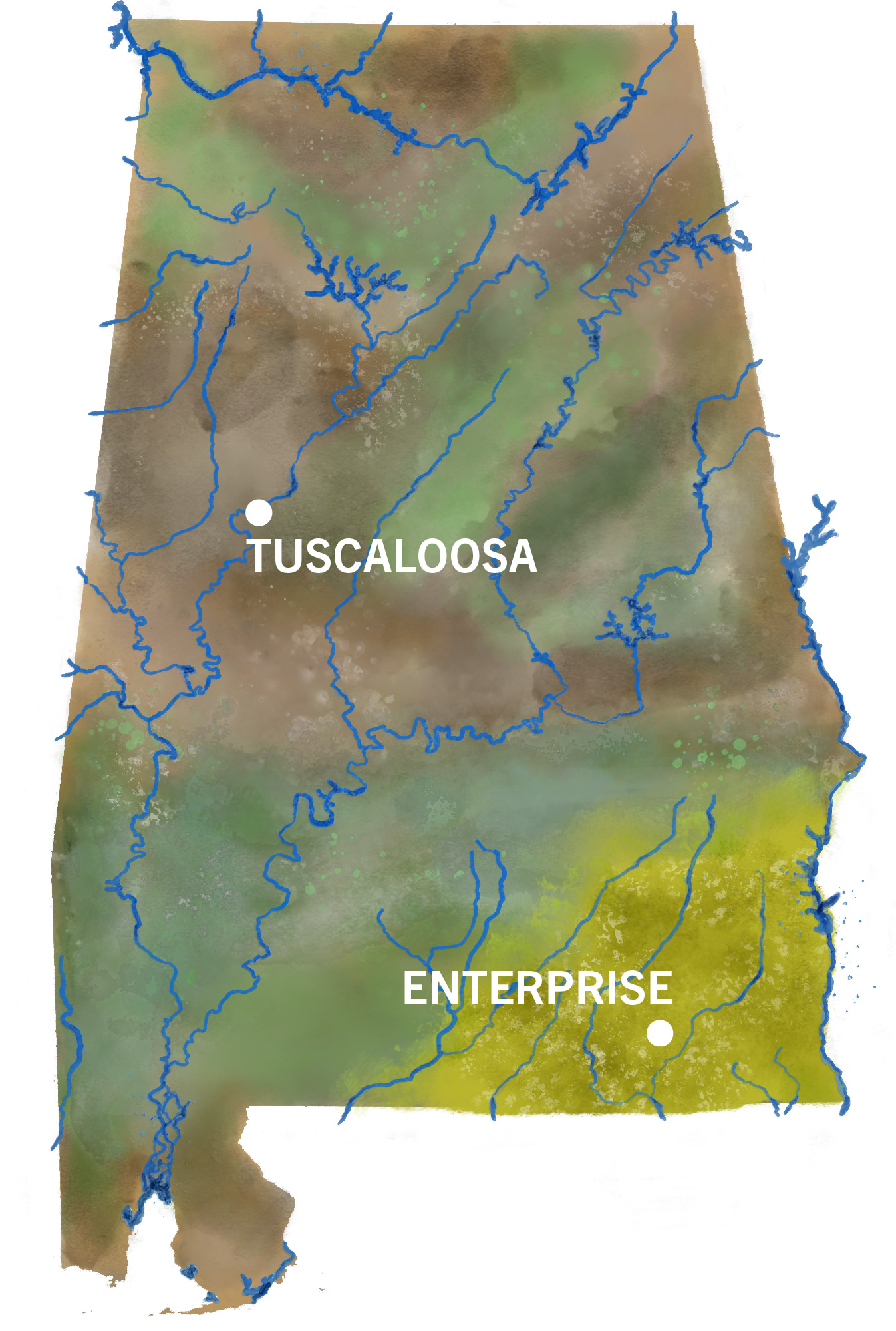
CRIMSON’s mission is to serve Alabama with innovative tools and reliable information that improve preparedness, better predict water hazards and enable swift recovery. To make that happen, the initiative will give communities across Alabama access to The University of Alabama’s water expertise. Based at the UA Wiregrass Hub in Enterprise, the initiative will use data analysis and forecasting tools to help communities prepare for and rapidly respond to floods, droughts and other water-related challenges. It is the fourth research entity of the Alabama Water Institute, or AWI, joining the CONSERVE Research Group, the Cooperative Institute for Research to Operations in Hydrology, or CIROH, and the Global Water Security Center.
The need is real. Flooding and other water hazards account for roughly 75% of presidential disaster declarations nationwide. Unlike some other states, Alabama has not had a single, integrated water information system built around its own communities, watersheds and infrastructure. CRIMSON’s first projects, three involving CIROH and one from CONSERVE, aim to change that.
The First Four Projects
CIROH
The Engine: The Alabama Water Model. Led by Dr. Sifan Koriche, CIROH hydrologic scientist, with CIROH Director Dr. Steve Burian as co-principal investigator, this project will develop a statewide hydrologic model that can describe past, present and future water conditions at the scales local and state decision-makers need. An initial version will cover the Choctawhatchee, Pea and Yellow river system in southeast Alabama, building on CIROH’s modeling tools and the Next Generation Water Resources Modeling Framework. Training is planned each year so students, planners and technical staff can put the model to work.
The Dashboard: Customized Water Intelligence. Led by Dr. Junho Song, CIROH hydrologic scientist, with Dr. Leigh Terry, associate professor of civil, construction and environmental engineering, as co-principal investigator, this project will create an online, map-based hub for water information. Its dashboards will be designed alongside the people who rely on them, such as emergency managers and water and wastewater utility operators. The team will also explore how artificial intelligence can help users find what they need.
The Playbook: Flood Risk and Early Warning. Led by Dr. Shane Crawford, assistant professor of civil, construction and environmental engineering, with Song, Burian and Dr. Lisa Davis, associate professor of geography and the environment, as co-principal investigators, this project will help communities understand flood risk to buildings and infrastructure and strengthen local flood early warning systems. Expect flood-risk maps, dam-break scenarios, practical evacuation tools, and early warning resources for training and outreach, all built with local input.
“CRIMSON is an incredible opportunity for water research at The University of Alabama to contribute to President Mohler’s vision of a future-ready flagship,” Burian said. “I am eager to see CIROH’s extensive research capability be translated by CRIMSON into benefits for Alabama. I am excited to strengthen relationships with the Alabama Emergency Management Agency and other partners in Alabama to help address the state’s critical water challenges and inspire the next generation of the workforce to solve them.”
CONSERVE
The Lay of the Land: Watershed and Ecosystem Health. Led by CONSERVE Director Dr. Michael Fedoroff, with Drs. Hazhir Karimi, Abba Ramadan and Phil Harris as co-principal investigators and team member Worth Pugh, the CONSERVE project will study the health of the Choctawhatchee-Pea River watershed. The team will work directly with community members, landowners and resource managers, and the project will culminate in practical, project-based recommendations for healthier watersheds and wildlife habitat.
“The Wiregrass region is home to vital forestry, agriculture and rich biodiversity, all of which depend heavily on healthy watersheds,” Karimi said. “Through the CRIMSON Water Initiative, our goal is to merge rigorous spatial data science with local community knowledge. By identifying critical ecological stressors, water quality patterns and data gaps, we are laying the foundation for healthier watersheds and long-term resilience.”
Together, the four projects position CRIMSON as a collaborative platform for applied water research in Alabama.
Built With Partners
CRIMSON is designed around the people who will use its tools. Through AWI’s partnerships with the National Oceanic and Atmospheric Administration National Water Center and the U.S. Geological Survey Hydrologic Instrumentation Facility, both in Tuscaloosa, the CIROH-led projects bring national-scale water monitoring and prediction capabilities to Alabama communities. Closer to home, the teams plan to work with state and local partners, including emergency management agencies, water and wastewater utilities, landowners and community members, as the projects take shape.
Follow the Work
Over the course of the projects, AWI will share what the teams learn and how the tools take shape, with one simple aim. CRIMSON will give Alabama communities the water information they need to prepare, respond and recover.
The Alabama Water Institute is one of The University of Alabama’s research institutes. AWI acts as a forum for interdisciplinary research and education by bringing together University researchers, students and staff to foster collaboration and a broad interdisciplinary focus on water issues that face our world today. AWI-affiliated researchers specialize in hydrologic and hydraulic modeling, water security and quality, remote sensing, biodiversity and watershed management and human health through synergies with AWI research programs. AWI’s research entities include the Global Water Security Center, the NOAA Cooperative Institute for Research to Operations in Hydrology, the CONSERVE Research Group and the CRIMSON Water Initiative.